

When my son started playing hockey years ago, I knew absolutely nothing about the sport except that it was expensive, time-consuming, and cold. I didn’t know anything about any sports. Let’s be honest-I still don’t know much about most other sports. If someone had taught a Hockey 101 class, I would have taken it. I felt like everyone around me was speaking a foreign language. It probably took me two full seasons to understand the game’s general language. I’m going to do any of you hockey newbies a favor and try to break down the basics here in plain English, so hopefully you don’t have to sneak off to the bathroom during intermission to Google “offsides” as I did or yell things that make hockey veterans roll their eyes at you. Are you ready? Here we go!
Icing? There’s Cake?!
I’m sorry to disappoint you, but there isn’t cake. What there is is a game that never stops. I don’t know if I’ve ever been to a boring hockey game. It’s even more exciting when you understand what’s going on. Let’s break it down!
The Basics
- Period – hockey games are comprised of 3 periods. The length of the period can vary by the level of hockey (youth, high school, collegiate, junion leagues, pro). The three regular periods are called Regulation time. If a game ends in a tie, the game will go to overtime. This also varies in time by level. See my post on the overtime drama of the Men’s Olympics game on the overtime rules for each level.
- Face Off – There are 5 players (plus the goalie) on the ice at once. These 5 players are called a line and the line is made up of three forwards (offense) and two are defense. The offense is comprised of one center and two wings. The center faces off against the center for the other team. The ref drops the puck between them. The center who gets the puck to his own teammates wins the faceoff. It is the offense’s job to move the puck and try to score. The defense is responsible for keeping the puck out of their own goalie’s net.
- Zones: the ice is divided into three zones for hockey. The defensive zone, the neutral zone, and the offensive zone. The red line in the middle is known as center ice, and this is the neutral zone. There are two blue lines, one third of the way from the goal toward the center on either end of the ice. These are the offensive and defensive zones.
Reasons for Whistles
- Icing – Nope, not cake. Or donuts. Icing is when a player shoots the puck from before the center line to across the goal line of the opposing team with nobody touching it. Icing is sometimes allowed, such as in a power play, at many levels. When it is allowed, and the refs don’t blow their whistles, then it’s called being waved off. If icing is called, the ref will blow the whistle, play will stop, and there will be a face-off in the zone that favors the team that did not ice the puck.
- Penalty – A penalty is when a player does something naughty. This can range from playing with a broken stick (I just learned recently that this is a real penalty!) to fighting, and everything in between. I will cover all the crazy penalties in another post later. When a player gets a penalty, they go to the penalty box, aka the box, aka the sin bin, for a specific amount of time depending on the penalty. Most are 2 minutes, but they can be as much as 10 & 2, which is a 10-minute penalty served by the offending player and an additional 2 minutes served by one of their teammates, leaving the line on the ice down by the number of players in the box.
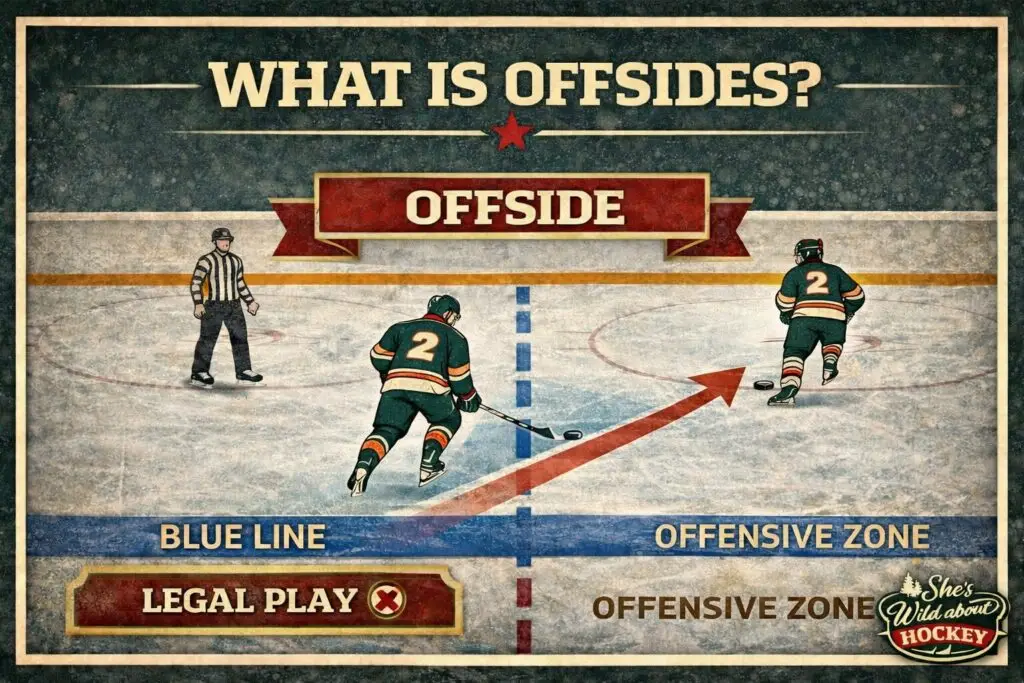
- Offsides – Sometimes, play will be stopped by the refs without a penalty involved. One of those reasons is offsides. This is one of the most common reasons for stopping play, aside from maybe icing, especially at the youth level. And for some reason, this is the one that took me forever to figure out (hence googling things in the bathroom). Basically, what it means is that while a player is taking the puck down to score on the other team’s goal, one of the other players from the same team as the person controlling the puck crosses the blue line into the other team’s zone before the puck crosses the blue line.
Other Things to Know
- Power Play – speaking of penalties, when a player is sent to the box, the game goes into a power play for the time the player is serving their penalty. The team that is at full strength (has all players on ice) is called the power play line, and the team that is playing shorthanded is called the penalty kill line. If the team on the power play scores while the player from the other team is serving their penalty, then that player will get released from the box early when the power play team scores. If they don’t score, then the player will serve their full penalty.
- Checking – When a player runs into a player on the opposing team on purpose. There are rules regarding when checking is allowed and when it’s not. This varies by age level. Checking is not typically allowed in girls’ and women’s hockey.
- Fighting – If someone were to ask you what the first thing that comes to mind when you think of hockey, I bet it’s the fights. However, it is not allowed in youth, high school, or college level at all. It can result in a 5 minute major penalty or getting ejected (kicked out of) the game. At the minor league and NHL levels, it is allowed. “Dropping the gloves” means two players take off their gloves, indicating they are going to fight. It usually is not broken up right away and both players get 2 minute minor penalties.
Class is Over…For Now
This is not an extensive list of hockey terms and rules, but hopefully it is enough to make you feel a little less confused the next time you watch a game. If you found this helpful, leave a comment below, and I will do a part two!
The post Hockey 101 – Class is in Session appeared first on She’s Wild about Hockey.
About The Author